
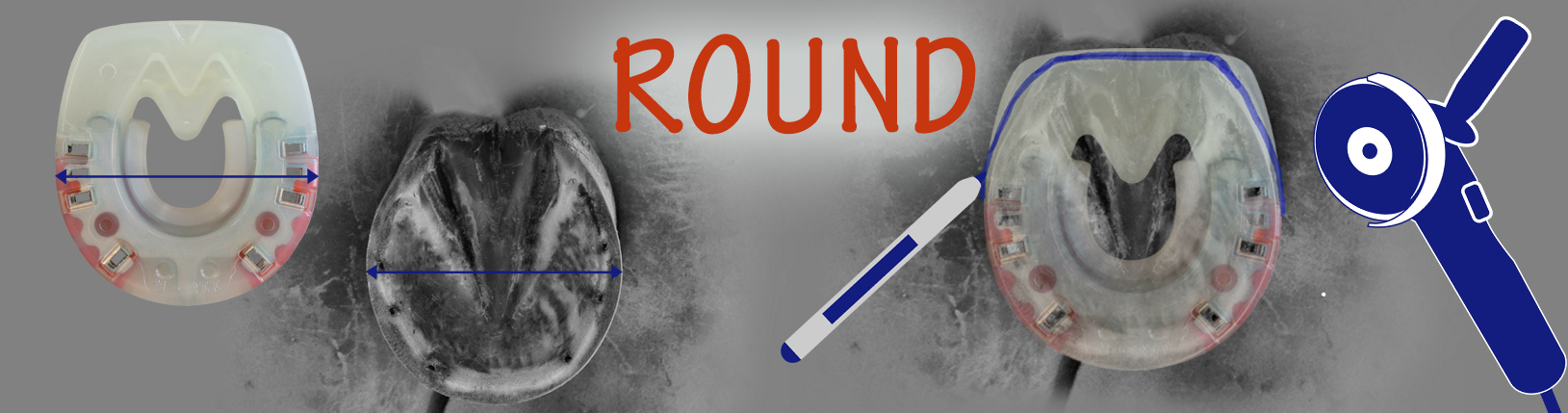
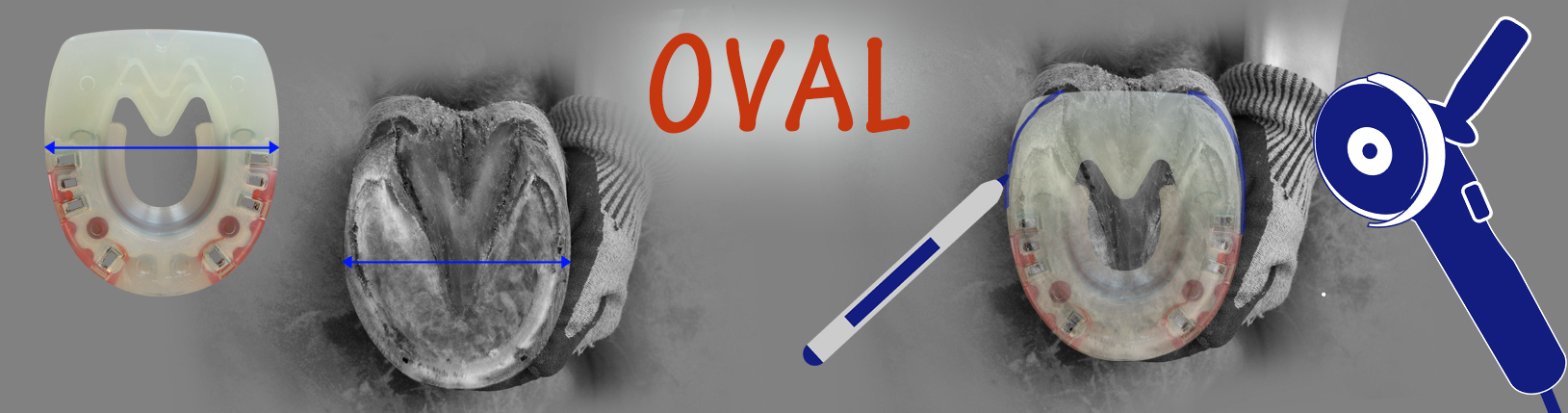
Sizes and Shapes
Determining Horseshoe Size and Shape – An Overview of Shapes and Sizes
An accurate fit is essential for effective hoof protection. On this page, you will find all the key information needed to determine the correct horseshoe shape and the appropriate horseshoe size for your horse’s hooves. Whether you are switching from barefoot, traditional steel shoes, or other plastic or composite horseshoes to Duplo horseshoes, or simply choosing horseshoes for a new horse, the central question is always the same: which horseshoe size and shape provide the best fit? Only a properly fitted horseshoe can perform its function effectively and support the hoof as intended.
If you are still unsure which size or shape is suitable for your horse, we are happy to help with practical resources: including our size charts, printable templates, and a detailed FAQ guide at the end of this page.
Our Range – Horseshoe Shapes, Models and Sizes at a Glance
We offer a wide range of composite horseshoes and fully plastic horseshoes. This allows us to cover a wide variety of hoof shapes and riding disciplines – from leisure and trail riding horses to sport horses, as well as therapeutic and orthopedic applications.
Shapes, Models and Sizes at a Glance
- More than 20 different horseshoe models
- Four shapes: round, oval, straight toe (STS ) and open-toe
- Finely graduated size system from 50 mm (1.97 inch) to 198 mm (7.80 inch).
Up to 182 mm in 4 mm steps, from 182 mm in 8 mm steps.
What Many People Don’t Realize – Important Tips for Choosing the Right Horseshoe
When selecting the right horseshoe shape and size, similar questions often arise: Does the horseshoe really fit? Can it be adjusted if necessary? And what happens if the horse’s hoof falls between two sizes? The following information provides helpful guidance and added confidence when making your decision.
Options for Individual Adjustments
If a horseshoe does not fit perfectly at first, it can often be adjusted. Especially with challenging hoof shapes, an off-the-shelf horseshoe may not always provide a perfect fit. With the necessary craftsmanship and, if required, suitable accessories, the horseshoe can be individually adjusted. The plastic coating of Duplo horseshoes can be ground down in specific areas or adjusted by adding material using Extensions . This allows the horseshoe to be lengthened or widened. Duplo horseshoes with a metal core can also be forged slightly narrower or wider, similar to traditional steel shoes.
Exchange and Return Options
If the selected shape or size still does not fit, you may return unused and clean horseshoes within 3 months of the invoice date. This means you can easily order several options if your horse’s hoof size falls between two sizes. Please note that the cost of return shipping must be covered by the customer. If you would like us to exchange the returned horseshoes for other sizes or different models, simply let us know. For orders outside the European Union, the relevant customs procedures must be taken into account – our customer service team will of course be happy to assist you. Further information about exchanges and returns can be found under FAQ → Service & Conditions.
Flexible Purchasing Options
Our plastic horseshoes and composite horseshoes are sold individually; not in pairs. This allows you to remain flexible when placing your order and to select the exact combination that best suits your horse’s individual hoof shape and needs.
Measuring the Hoof – How to Do It Correctly
Method 1: Using a Tape Measure or Ruler
First, measure the widest part of the hoof on the sole side using a tape measure or ruler. This point is usually located slightly behind the tip of the frog.

Method 2: Free Templates to Determine the Correct Horseshoe Size

Our free templates help you quickly and easily determine the correct horseshoe size for your horse. We provide a separate template for round and oval composite horseshoes as well as for the STS special shape. Each template consists of two A4 pages that you can print and tape together. Please use the small scale on the templates to check your printer settings.
Tip: For greater stability, you can glue the template onto cardboard.
How to Determine the Correct Horseshoe Size:
- Trace the shape of the hoof on paper, cut it out, and compare it with the template, or:
- Hold the template directly against the hoof or place the hoof on top of it, or:
- Cut out the possible sizes and compare them directly on the hoof (particularly precise).
Approximate Dimensions of Our Composite and Plastic Horseshoes
In the following section, you will find a clear overview of the technical specifications of our horseshoes. The information is organized into separate sections for standard horseshoes, pony horseshoes, and open-toe horseshoes. For each shape, both length and width are listed. These measurements will help you select the appropriate model and the correct horseshoe size for your horse.
All measurements are given in millimeters, with converted and rounded values also provided in inches. Minor production-related variations may occur, as well as slight dimensional differences in model variants that have not yet been updated.
You may also find the page "Adjusting the Horseshoe to the Hoof" helpful. It explains to which extend the plastic coating can be modified without affecting the functionality of the horseshoe.

| Horseshoes with and without quarter clips | STS models | ||
|---|---|---|---|
| Width / Horseshoe Size (mm / inch) |
Length – round shape (mm / inch) |
Length – oval shape (mm / inch) |
Length – round shape with straight toe (mm / inch) |
| 98 / 3.86 | — | 112.5 / 4.43 | — |
| 102 / 4.02 | 111.5 / 4.39 | 117 / 4.61 | 105 / 4.13 |
| 106 / 4.17 | 116 / 4.57 | 121.5 / 4.77 | 109 / 4.29 |
| 110 / 4.33 | 120.5 / 4.74 | 126 / 4.96 | 113 / 4.45 |
| 114 / 4.49 | 125 / 4.92 | 130.5 / 5.14 | 117 / 4.61 |
| 118 / 4.65 | 129 / 5.08 | 135 / 5.31 | 121 / 4.76 |
| 122 / 4.80 | 133.5 / 5.26 | 140 / 5.51 | 125.5 / 4.94 |
| 126 / 4.96 | 138 / 5.43 | 144.5 / 5.69 | 129.5 / 5.10 |
| 130 / 5.12 | 142.5 / 5.61 | 149 / 5.87 | 133.5 / 5.26 |
| 134 / 5.28 | 147 / 5.79 | 153.5 / 6.04 | 138 / 5.43 |
| 138 / 5.43 | 151 / 5.94 | 158 / 6.22 | 142 / 5.59 |
| 142 / 5.59 | 155.5 / 6.12 | 163 / 6.42 | 146 / 5.75 |
| 146 / 5.75 | 160 / 6.30 | 167.5 / 6.60 | 150 / 5.91 |
| 150 / 5.91 | 164.5 / 6.48 | 172 / 6.77 | 154 / 6.06 |
| 154 / 6.06 | 169 / 6.65 | 176.5 / 6.95 | 158 / 6.22 |
| 158 / 6.22 | 173 / 6.81 | 181 / 7.13 | — |
| 162 / 6.38 | 177.5 / 6.99 | 186 / 7.32 | — |
| 166 / 6.54 | 182 / 7.17 | 190.5 / 7.50 | — |
| 170 / 6.69 | 186 / 7.32 | 195 / 7.68 | — |
| 174 / 6.85 | 190.5 / 7.50 | 199.5 / 7.85 | — |
| 178 / 7.01 | 195 / 7.68 | 204 / 8.03 | — |
| 182 / 7.17 | 199.5 / 7.85 | 209 / 8.23 | — |
| 190 / 7.48 | 208 / 8.19 | 218 / 8.58 | — |
| 198 / 7.80 | 217 / 8.54 | 227 / 8.94 | — |
Pony Horseshoes

| Width / Horseshoe Size (mm / inch) |
Length – Round Shape (mm / inch) |
Height – Round Shape (mm / inch) |
Length – Oval Shape (mm / inch) |
Height – Oval Shape (mm / inch) |
|---|---|---|---|---|
| 50 / 1.97 | 55 / 2.16 | 11 / 0.43 | 57 / 2.24 | 11 / 0.43 |
| 54 / 2.13 | 59 / 2.32 | 11 / 0.43 | 62 / 2.44 | 11 / 0.43 |
| 58 / 2.28 | 63.5 / 2.50 | 11 / 0.43 | 66.5 / 2.62 | 11 / 0.43 |
| 62 / 2.44 | 68 / 2.68 | 11 / 0.43 | 71 / 2.80 | 11 / 0.43 |
| 66 / 2.60 | 72 / 2.84 | 12 / 0.47 | 75.5 / 2.97 | 12 / 0.47 |
| 70 / 2.76 | 76.5 / 3.01 | 12 / 0.47 | 80 / 3.15 | 12 / 0.47 |
| 74 / 2.91 | 81 / 3.19 | 12 / 0.47 | 84.5 / 3.33 | 12 / 0.47 |
| 78 / 3.07 | 85.5 / 3.37 | 12 / 0.47 | 89.5 / 3.52 | 12 / 0.47 |
| 82 / 3.23 | 90 / 3.54 | 13 / 0.51 | 94 / 3.70 | 13 / 0.51 |
| 86 / 3.39 | 94 / 3.70 | 13 / 0.51 | 98.5 / 3.88 | 13 / 0.51 |
| 90 / 3.54 | 98.5 / 3.88 | 13 / 0.51 | 103 / 4.06 | 13 / 0.51 |
| 94 / 3.70 | 103 / 4.06 | 14 / 0.55 | 107.5 / 4.23 | 13 / 0.51 |
| 98 / 3.86 | 107.5 / 4.23 | 14 / 0.55 | — | — |
Open-Toed Composite Horseshoes
Please note that our open-toed composite horseshoes are available in a round shape only. Because the position of the central stabilizing bar is particularly important in this model, both length measurements are listed for reference.

| Width / Horseshoe Size (mm / inch) |
Length 1 – to the Outer Edge of the Central Bar (mm / inch) |
Length 2 – Overall Length (mm / inch) |
|---|---|---|
| 110 / 4.33 | 88 / 3.47 | 110 / 4.33 |
| 114 / 4.49 | 91 / 3.58 | 114 / 4.49 |
| 118 / 4.65 | 95 / 3.74 | 118 / 4.65 |
| 122 / 4.80 | 98 / 3.86 | 122 / 4.80 |
| 126 / 4.96 | 101 / 3.98 | 126 / 4.96 |
| 130 / 5.12 | 104 / 4.09 | 130 / 5.12 |
| 134 / 5.28 | 107 / 4.21 | 134 / 5.28 |
| 138 / 5.43 | 111 / 4.37 | 138 / 5.43 |
| 142 / 5.59 | 113 / 4.45 | 142 / 5.59 |
| 146 / 5.75 | 117 / 4.61 | 146 / 5.75 |
| 150 / 5.91 | 120 / 4.72 | 150 / 5.91 |
| 154 / 6.06 | 124 / 4.88 | 154 / 6.06 |
| 158 / 6.22 | 127 / 5.00 | 157 / 6.18 |
| 162 / 6.38 | 130 / 5.11 | 161 / 6.34 |
| 166 / 6.54 | 133 / 5.24 | 164 / 6.46 |
| 170 / 6.69 | 136 / 5.35 | 168 / 6.61 |
FAQ – Frequently Asked Questions About Choosing the Right Horseshoe Size and Shape
Whether your horse wears traditional steel shoes, urethane horseshoes, composite horseshoes, or hoof boots, choosing the correct size and proper fit is essential for comfort, performance, and hoof health. A horseshoe that does not fit properly can affect the hoof and may lead to uneven loading or unnecessary strain.
We know it from everyday life: shoes that are too tight or too large can cause blisters, pressure points, and an uncomfortable walking experience. If the foot moves around inside the shoe or is restricted, our natural gait changes automatically. In a similar way, horses can also react to an unsuitable horseshoe shape or size.
With this FAQ guide, we aim to help you choose the most suitable horseshoe shape and size for your horse—whether you are considering urethane horseshoes, composite horseshoes, or traditional steel shoes.
What Horseshoe Size Does My Horse Need?
To determine the correct horseshoe size for your horse, the hoof should ideally be unshod. The hoof should also be trimmed and prepared so that the horseshoe could be applied in the next step. If measurements are taken on a shod or untrimmed hoof, the result may not be accurate.
Which Measurements Are Needed to Determine the Correct Horseshoe Size?
To determine the correct horseshoe size, you need the width and the length of the hoof. The widest point of the hoof is usually located slightly behind the tip of the frog .
How Do You Determine the Correct Horseshoe Size?
There are two ways to find the right horseshoe size: you can either measure the hoof with a tape measure or ruler, or use our practical templates. We provide separate templates for round horseshoes, oval horseshoes, and STS horseshoes. For our open-toe horseshoes, templates are not available, so the hoof needs to be measured with a tape measure or ruler. When choosing open-toe horseshoes, please make sure to pay close attention to the position of the central bar.
How Do I Measure a Hoof Correctly to Determine the Right Horseshoe Size?
The hoof width is measured at the widest point of the hoof, which is usually located slightly behind the tip of the frog. The hoof length runs from the tip of the toe to the end of the heels. Accurate measurements in millimeters are important. Ideally, the hoof should be freshly trimmed when taking measurements. If this is not possible, you can also use the previous horseshoe as a reference. If you are unsure, we recommend ordering two sizes to compare.
Are Horseshoe Sizes Standardized?
No. There is no universal standard for horseshoe sizes. Each manufacturer uses its own size charts and model shapes. For this reason, it is important not to rely solely on the stated size, but always compare the actual hoof measurements in millimeters or inches with the manufacturer’s specifications. To help with this, you will find the exact dimensions of our Duplo horseshoes listed earlier on this page.
What Dimensions Does a Horseshoe Have?
The exact dimensions of a horseshoe vary depending on the manufacturer and the model. For our own horseshoes, you will find the corresponding measurements in mm and inches listed on this page.
Which Horseshoe Shape Is the Right One?
To choose the correct horseshoe shape, look at the underside of the hoof as a whole and assess whether it appears more round or oval. In most cases, oval horseshoes are more suitable for the hind hooves, while round horseshoes and special shapes with a straight toe (STS) or an open toe are typically used on the front hooves. As always, exceptions can occur.
What Is Special About the Duplo STS Shape?
Our composite horseshoes with a straight toe, known as Straight Toe Shoes (STS), allow the horseshoe to be set slightly further backwards, which can help achieve an earlier breakover point . For this reason, the decision to use an STS shoe is not based solely on hoof shape, but also on the horse’s individual movement mechanics. On STS models, the quarter clips are set slightly further back than on our standard round shape.
Can I Choose Horseshoes Myself, or Should the Farrier Decide?
In general, the selection of the appropriate horseshoe size and shape should be made in close consultation with a farrier or hoof care specialist. While many horse owners research suitable horseshoes online, the final decision should always take factors such as hoof balance, conformation, movement, and intended use into account. Proper fitting and professional application are essential to help prevent imbalance, excessive strain, or long-term hoof problems.
What Happens If the Horseshoe Size or Shape Does Not Fit?
An incorrect horseshoe size or shape can negatively affect hoof health. Horseshoes that are too small can cause constriction, while shoes that are too large increase the risk of the horse stepping on them or catching them. Over time, poorly fitting horseshoes may lead to hoof wall cracks, contracted heels, uneven loading, and even lameness. Choosing the correct horseshoe and checking the fit regularly are therefore essential for maintaining the horse’s hoof health.
How Can I Tell If a Horseshoe Fits Properly?
The selection of a suitable horseshoe is based on the shape and measurements of the hoof, together with
our size chart. These details help determine an appropriate horseshoe for your horse.
When choosing a horseshoe, it is important to consider how a shoe should typically fit: in most cases,
it
follows the outer contour of the hoof and provides sufficient support in the heel area without being too
long, as excessive length can increase the risk of the horse stepping on the shoe or injuring itself.
Depending on the individual hoof, however, it may sometimes be advisable to choose a slightly wider or
longer shoe. This assessment should be made by the professional working with the horse.
In addition to the basic measurements, several other factors should also be considered:
- For nailed horseshoes, the nailing slots must align correctly with the white line.
- For horseshoes with threaded holes in the heel area, make sure that the threads are not positioned too far back. Otherwise, the risk of the horse stepping on the shoe increases, and studs may create unwanted pressure on sensitive parts of the hoof.
- If a glue-on horseshoe is planned, allow for approximately 1 mm of additional material in the area of the weld seam.
Whether a horseshoe fits properly or can be adjusted to fit cannot be determined in general terms. Ultimately, the overall situation of the individual horse is always decisive.
What If No Horseshoe Seems to Fit?
If no shape or size appears to fit at first, this does not mean that a suitable solution cannot be found.
With the necessary craftsmanship and, if required, the right accessories, a horseshoe can often be
individually adjusted.
The plastic coating of Duplo horseshoes can be ground down in specific areas or expanded by adding
material using welded plastic strips (extensions). This allows the horseshoe to be lengthened or widened.
Duplo horseshoes with a metal core can also be forged slightly narrower or wider, similar to traditional
steel shoes.
You can find further information on this topic under FAQ → Adjusting the Horseshoe to the Hoof.
Last updated: 09.03.2026